

Raqs al Assaya or Dancing with a Cane
Last Updated on February 4, 2024

Origins and Outfits and Tahtib
The idea of belly dancing with canes originates from Egyptian folkloric dances, in particular from the Saiidi region in Upper Egypt.
The traditional male dance is called Tahtib (also transliterated Tahteeb) and it is a martial art, accompanied by music, in which the two fighters use a stick, called Assaya in Arabic, to hit and fence each other’s hits.
Tahtib as a martial art must have ancient roots as images of men fighting with sticks have been found depicted on ancient Egyptian stones.
You can see below an example of Tahtib performed as a martial art at a martial arts festival in Paris.
Later, (from the 1960s and 70s) Tahteeb was adapted for the stage by Mahmoud Reda, an Egyptian dancer, and choreographer who traveled across Egypt observing traditional dances, which inspired his choreographies that were adaptations of these dances for the stage.
See below an example of Tahtib adapted for the stage with a man and a woman dancing.
Women incorporated the stick as a belly dance prop and used it to imitate this typically masculine dance in a flirtatious and cheeky way.
Nowadays, dancing with an Assaya is often part of Raqs sharqi shows. This dance is called in Arabic Raqs al Assaya, literally cane dance.
The stick used by women is usually a bamboo cane (thinner compared to the one used for Tahtib), which may have a hooked end, and it can be decorated with sequins.
If the dance is folkloric, usually the Assaya will be a plain bamboo cane; otherwise, for Raqs sharqi performances, it can be sequinned.
The performer usually wears a long tunic (also called in Arabic Galabeya), a hip scarf with coins, and a headscarf, which is traditional but it is also useful to keep the Assaya in place when balancing it on the dancer’s head.
Saidi Rhythm
The rhythm that usually accompanies Raqs al Assaya is the Saidi rhythm (read more on Saiidi on our Arabic rhythms page), which is also used for Tahtib.
This is why belly dancing with the cane is often referred to as Saidi dance.
Saiidi is a strong and earthy rhythm; hence, the movements associated with it must also be strong, very well-grounded, with a proud posture and movements pointing to the earth.
F (for example, movements are often performed on flat or semi-flat feet rather the standing on feet balls).
The instruments used to play Saiidi rhythm are very traditional ones, such as the mizmar (similar to a flute), the rebab (a string instrument), and percussion instruments such as daff-duff, Mazhar, and tabla.
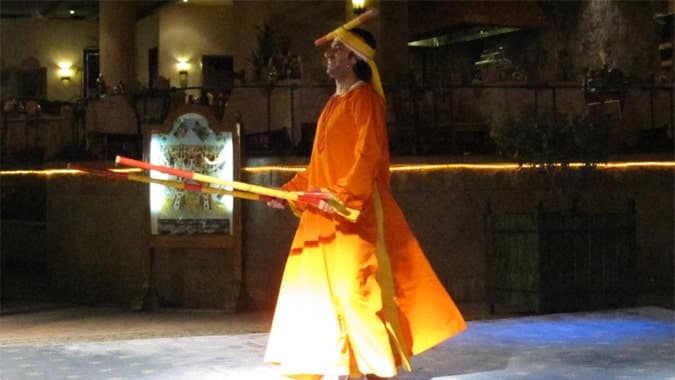
Raqs al Assaya Movements and Steps
There are many movements that a dancer can do when performing al Assaya.
She can balance it on her head while moving her hips; or turn whilst holding the Assaya in the air either above her head, at chest level, or at hips level.
One can also balance the stick on one of her hips while doing small hip drops; hold it in front of her either at chest level, while doing shoulder shimmies, or at hips level while moving her hips, or in front of her to accompany a camel.
It is possible also to balance the stick on the shoulders while doing some steps; accompany the Assaya movements with grounded small jumps, or a dancer can decide to keep the cane in place vertically on the ground with one hand and dance around it.
Another typical move associated with cane dancing is twirling it between the dancer’s fingers.
This move looks good when the rhythm becomes particularly lively.
Swirling the stick properly takes some practice. The dancer needs to hold the stick in his/her hand from the non-hooked side, between the base of her thumb and her palm, closing the fingers around the stick.
The Assaya must be held straight, with the hooked side upwards, and parallel to the dancer’s body.
Then, still keeping the stick straight and parallel to the body, the dancer needs to open her hand with the palm facing upwards and let the stick fall down while still holding the non-hooked end between the base of her thumb and the open palm.
Lastly, the dancer needs to grasp the stick with the strength of her fingers, in order to bring it back to its original upright position.
It is very important that the cane is always straight and parallel to the body. It takes a bit of practice to master and it can be tiring at first, but it is just a matter of practice.
If you are left-handed like me, you still will need to learn how to twirl the cane with both hands, just because, if you are dancing as part of the group, everybody needs to use the same hand (which is invariably the right).
I have learnt to use both hands, but when doing solos I prefer to twirl the assaya with my left hand.
This twirling can be repeated a few times in a row and it can be associated to hip moves.
Also, in between twirling, the dancer can let the hooked end of the stick rest on the floor and kick it lightly with her foot, to make it go upwards and then resume the twirling.
Dr Valeria Lo Iacono
This twirling can be repeated a few times in a row and it can be associated to hip moves.
Also, in between twirling, the dancer can let the hooked end of the stick rest on the floor and kick it lightly with her foot, to make it go upwards, and then resume the twirling.
Types of assaya and where to buy them
For Raqs Sharqi, there are two types of canes: one which is thinner and lighter, and another one thicker covered in sequins and a bit heavier.
Which one to use depends on you and how you feel more comfortable.
I find that the thinner ones are easier to move quickly and I do not get so tired as they are lighter.
However, they are more difficult to control, while the thicker ones with sequins are more cumbersome, but at the same time easier to keep control of (they will not fly off if you get carried away twirling).
For me, it depends on the dance routine and how long I am going to twirl the cane for to decide which type to use.
There are also different lengths of cane; the right one for you should reach your waist and be no higher.
You can buy assaya online from specialiZed belly dance shops, on eBay, on Amazon, or (which I think it is a better option, as it will allow you to see the assaya in person and see if it is the right size) at hafla or belly dance festivals where there are usually stalls selling merchandise.
If you are lucky enough to travel to Cairo, the best place to buy assaya is Al Wikalah in the Khan el-Khalili market, which has three floors full of belly dance gear and accessories and where you can find canes of every color and style.
I bought a few there and they cost me the equivalent of about one British pound each.
Useful Resources on Raqs al Assaya
An instructional DVD that I found particularly useful when learning assaya technique, is Raks Al Asaya by Virginia.
This DVD is good if you need to learn the basics of how to use this prop.
Virginia starts with the basics, such as how to hold the stick and how to twirl it, to teaching some simple steps and combinations from which you can develop her own performance once you have grasped the basics.
Virginia’s instructions are very clear and thorough.

The following two tabs change content below.


Dr Valeria Lo Iacono is a belly dancer and a dance researcher with a PhD in dance and heritage. Valeria also teaches and performs as a belly dance but also enjoys learning ballet, jazz dance and other dance genres.
Latest posts by Dr Valeria Lo Iacono (see all)
- Belly Dancing over the Age of 40, 50 and Beyond - January 21, 2024
- Health Benefits of Belly Dance - January 20, 2024
- 10 Countries for Learning Belly Dance - January 18, 2024


