

Arabic Rhythms used in Belly Dancing
Last Updated on February 1, 2024
Arabic rhythms used in belly dancing, have helped me a lot as a belly dancer. so in this post, I will explain the most common rhythms used and a little about each. Please add your comments at the bottom of this post if you have any thoughts also!

Arabic Rhythms
You do not need to be able to play the
The Arabic rhythms used in belly dance are many, I highlight here only some of them, most of which are Egyptian, the ones I have come across more often during my years of studying Arabic dance.
Arabic rhythms are a succession of ‘doms’ and ‘taks’. Dom is a bass beat, whereas
Doms are usually more suited for grounded downward movements, such as hip drops, while taks are better accompanied by hip lifts.
Usually, Egyptian rhythms start with a dom, also they have more doms in them than for example Turkish rhythms and require more grounded movements, such as hip drops.
Turkish rhythms consist of fewer doms and more taks than Egyptian rhythms and therefore Turkish belly dance has more hip lifts.
Every rhythm, which is a pattern of beats and accent, can then be played at different speeds or tempo, such as, for example, 4/4, 2/4 or 8/4.
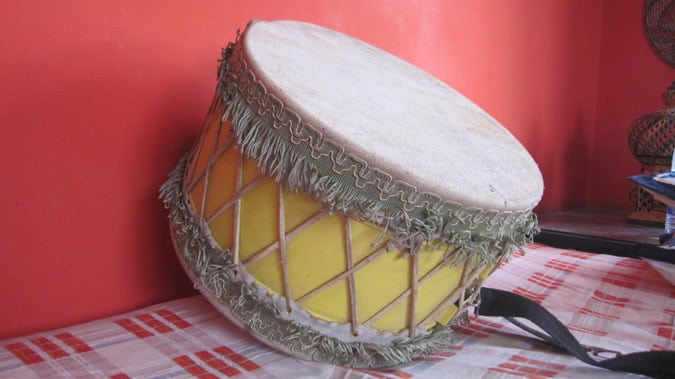
Baladi Rhythms
There are many Baladi rhythms, but the most common ones are the following:
- Dom-dom tak-a-tak.
- Dom tak-a-tak.
Or:
- Dom-dom… tak dom… tak
Maqsoum Rhythm
- Dom-tak… tak dom… tak
Saidi Rhythm
The Saidi rhythm comes from upper Egypt and is used to perform a martial art dance called Tahteeb and also for the Arab stallions dance.
It is very grounded and its particular sequence of doms and
the dancer’s weight shift quite rapidly.
Women belly dancers use this rhythm, especially when dancing with a stick, almost to imitate the martial stance of male dancers. The rhythm goes: Dom-
Malfuf
This is a fast rhythm, with a gliding feeling, often used by belly dancers to make an entry and it goes:
Dom, tak-tak, dom, tak-tak
Zaar
This rhytm is used to perform trance dances and it goes: Dom, a-tak-a, dom, a-tak-a
Masmoudi
- Dom-dom tak-dom tak-tak
This group of doms and taks can be repeated two or three times and there are also other ways of playing this rhythm, but this is one of the most common.
Fallahi
The farmers of Egypt created Fallahi, which is a fast and repetitive rhythm. It can be played in various ways, but the basic structure is: Dom-tak-tak, dom-tak
Chiftitelli or Chiftetelli
This rhythm is used in Turkish and Greek belly dance; it is slow and sensual and it suggests grounded and
circular moves. It goes:
- Dom-tak-tak, tak-tak
- Dom-dom tak
As a reference for studying and understanding a bit more about Arabic Rhythms I recommend Hossam Ramzy’s CD ‘Rhythms of the Nile’.
This is an instructional double CD, where Hossam Ramzy explains the most common Egyptian rhythms that a belly dancer can come across. All the rhythms are clearly explained and played.
The following two tabs change content below.


Dr Valeria Lo Iacono is a belly dancer and a dance researcher with a PhD in dance and heritage. Valeria also teaches and performs as a belly dance but also enjoys learning ballet, jazz dance and other dance genres.
Latest posts by Dr Valeria Lo Iacono (see all)
- Belly Dancing over the Age of 40, 50 and Beyond - February 1, 2025
- Health Benefits of Belly Dance - January 20, 2024
- 10 Countries for Learning Belly Dance - January 18, 2024
Related Posts


Burlesque and Belly Dance: Differences and Similarities


How Practising Contemporary Dance can help Belly Dancers

Health Benefits of Belly Dance


Belly Dance Holidays with Nawarra

What is Taqsim and How Do I Dance to It?


Belly Dance and Mental Wellbeing


Tips for Organising a Belly Dance Hafla


Interview with Sadie Marquardt, from Denver, Colorado


Interview with Brenna Crowley, Giselle, and Sarah Skinner
6 thoughts on “Arabic Rhythms used in Belly Dancing”
Comments are closed.


Information on rhythm on belly dancing very useful. Thanks for your help.
No problem Rafael. Glad you found it useful.
Hi, the rhythm is call “ayub” not “zaar”. Zaar is the head movement where you go around and around with your head continuously and you do it in the rhythm Ayub.
Thank you for commenting and for providing this extra information!
No, the ayub rhythm CAN also be called Zaar…you don’t hear the name used very often, but it is called that sometimes.
Hi Bill. Thank you for that regards the Zaar as I did not realise that. cheers, Valeria